

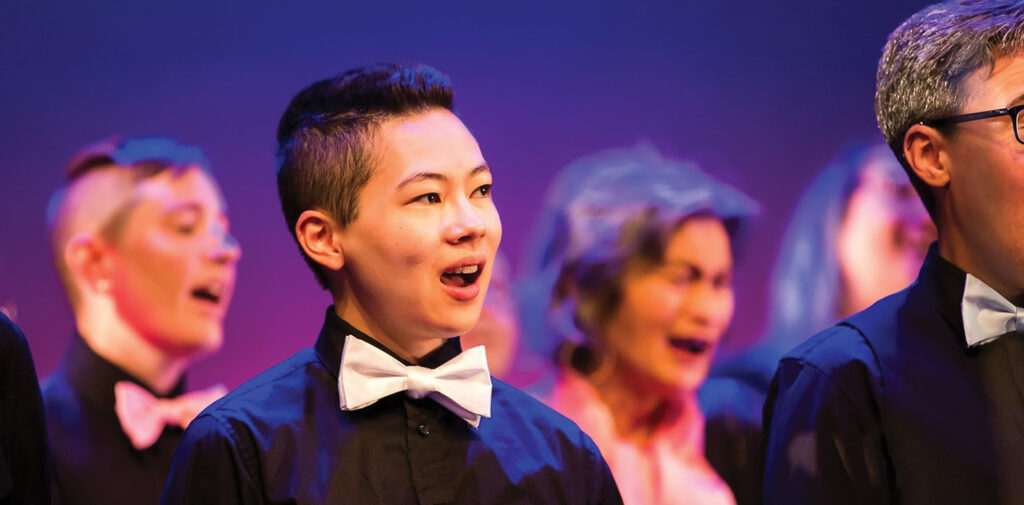
This spring CMC proudly participated in a choral collaboration in celebration for in an affirming celebration of identity, joy, and resilience featuring an intergenerational mix of professional, community, and youth singers. In partnership with 21V, a professional treble ensemble of soprano and altos of all gender identities and their pilot Transgender Youth Choir Project, 10 young trans and gender-expansive voices joined 21V and CMC’s New Voices Bay Area Transgender, Intersex & Genderqueer Chorus in creating community and exploring the joy of music in preparation for the culminating concert Voices Taking Space on April 12. The rehearsals and repertoire highlighted the vibrant landscape of 21st century music from across the Americas.
Through music and storytelling, the program uplifted trans voices and experiences, weaving
together newly commissioned works and contemporary choral music by bold composers from
across the continent, featuring a world premiere by CMC Faculty and composer Robin Estrada. Alongside works by Ted Hearne, Mari Esabel Valverde, and other bold composers, the concert culminated in a powerful joint performance of Will the Circle Be Unbroken, the beloved Appalachia hymn reimagined as an affirmation of shared humanity.
Composer Robin Estrada, who leads several choirs in CMC’s Neighborhood Choir Program for Older Adults and Adults with Disabilities, was commissioned for the collaboration, strengthening the links between CMC and 21V—in which several CMC voice faculty members sing (Tristana Ferreyra-Rantalaiho, Julia Grizzell, and NVBA co-directors Reuben Zellman and Jessalynn Levine). Robin shared some of the inspirations and challenges in composing the work for the world premiere Be Seen, Be Heard, Be Found.
Major inspirations for the work as connected to the trans experience were ideas connected to diaspora and change—singers moving ranges as they may begin hormones, from space to space, and adjusting to where you are as life changes. The text and content of the piece was inspired by the iconic queer writer Gertrude Stein’s quote “There is no there, there” in reference to her childhood home in Oakland, as well as the HERE/THERE public art sculpture near the Ashby BART Station in Berkeley.
The libretto of “Be Heard, Be Seen, Be Found” reads:
Here we are.
Where she becomes whole. Here are we.
Where he finds his name
where none was given.
There is no there, there—
Only being one’s being
We are here!
Where their truth lies.
Where our lives lived.
Robin, who originally grew up in the Philippines, often incorporates elements of Philippine traditional music into compositions, and included these textures in Be Seen, Be Heard, Be Found as an homage to change, identity, and evolution. The idea of place from these inspirations helps to affirm that TIGQ people and voices are here, there, and everywhere.
One of the unique challenges that Robin faced in the composition process was writing effectively for a very wide range of singers. Some singers joining may not have much experience at all, and others are seasoned professionals, so Robin and 21V’s director Martin Benvenuto wanted to create a piece that played to the strengths of such a diverse collaboration of ensembles. Robin wrote a piece that uses both unisons for the group, as well as having groups of singers break off in different complex textures and harmonies, and converge again. “This allows for everyone to feel comfortable no matter their range or experience, and reflects the uniqueness of our experiences too: that we can sing in unison but can have different views. We can be apart and come together again through music. In this way it’s a bit of a political reaction as well.”
Ultimately, the aim for the piece—and the concert in whole—was for both participants and audiences to have an open mind, open ears to techniques or sounds that may be unfamiliar, and find connection and joy through community, collaboration, and creativity.