

After years of research, reflection, and musical exploration, San Francisco composer, singer, and guitarist David James created Mission Rebel No. 1: Looking for Rev. Jesse James — a deeply personal work examining the life of his father, Rev. Jesse James, a preacher and activist in the Mission District.
What led him to center an album on his father?
“I’ve worked for a number of years with composer/clarinetist Beth Custer, performing her original music that included compositions for theater, dance, and film (see: the Soviet-era silent Georgian farce, “My Grandmother”). The bassist in some of these projects was Lisa Mezzacappa, who is another performer/composer who creates these large, improbable, and wonderful thematic works for ensembles of varying sizes (see: the serial podcast opera, “The Electronic Lover”, and “Glorious Ravage”). Being involved in these thematic projects, and seeing others by both Custer and Mezzacappa were foundational to my thoughts about writing something centered around my father for the ensemble GPS.”
While researching his father’s life, James made a discovery that shaped the entire project.
“I had already been researching my father’s life––he passed in 2005––when I discovered film footage of him online: he’s speaking to an unseen interviewer at the Mission Rebels headquarters/clubhouse in 1968. This footage was startling to find, to say the least, as its 15 minutes (watermarked and broken into 7 parts) contained the most I’d ever heard Rev. Jesse James speak about his growing up, his time in jail and prison, the Rebels, his addiction(s). The footage also contained shots of my father holding a one year-old David, which shocked me in its tenderness. I did not grow up with him, and seeing this gave me a sense of his depth of feeling which almost certainly informed my approach.”
Rather than write a straightforward biography, James built a layered composition around real words and multiple perspectives.
“The discovery of this and other footage of my father––coming after my then-recent “close-up” exposure to longer-form thematic works––led me down a compositional path that came to include: using text from interviews I’d transcribed as lyrics; using the singing voices of the instrumentalists, including as inspiration: I’d given each of the instrumentalists a newspaper headline, and asked them to record themselves improvising singing the headline. I then composed movements and sections around these improvisations. I wanted the composition to have the “arc” of a story, even though it wasn’t to be a biographical telling my father’s life. I thought of it as different facets of my fathers life, as seen from different perspectives: his family, community youth, the press, and my own memories.”
The suite moves through a half-century of Black musical forms.
“Well, I think I just allowed myself to follow the needs of each section of the piece. With the exception of “Circa 1928” (which was a conscious effort to approximate what I thought might come out of New York City in that year of Jesse’s birth), and “J.J.’s Boogaloo” (a piece he might dance to), I tried to let each piece dictate its own style and shape. I have worked in record stores in the Bay Area since I was a teenager, and have been exposed to and interested in all kinds of music from across eras and borders. I’ve also played in an array of styles, from outright noise to hip-hop to afrobeat to chamber jazz. I don’t really privilege any ones over any others, but I allow them all to come into play as they come.”
Performing the work in the Mission was essential.
“With the subject matter including my father’s work in the Mission District, I have wanted to make most every iteration of this piece–– from the work-in-progress performances, to the premiere of the full live presentation, to the album release celebration––inexpensive and accessible, and close to the Mission.
Two notes: The first place I lived was at 21st and Alabama. My father returned to the Mission in the last years of his life, living for a few years at the Bethany Center.”
The album is also part of Queen Bee Records’ “12 albums in 12 months” series.
“What Lisa Mezzacappa has accomplished with Queen Bee Records’ “12 albums in 12 months” program is really amazing. It’s a great document of the creative music scene she’s involved in, and though mine is an outlier in some ways––vocal-centered at times, coming from a Black music “place”––I am very proud to be a part of it.”
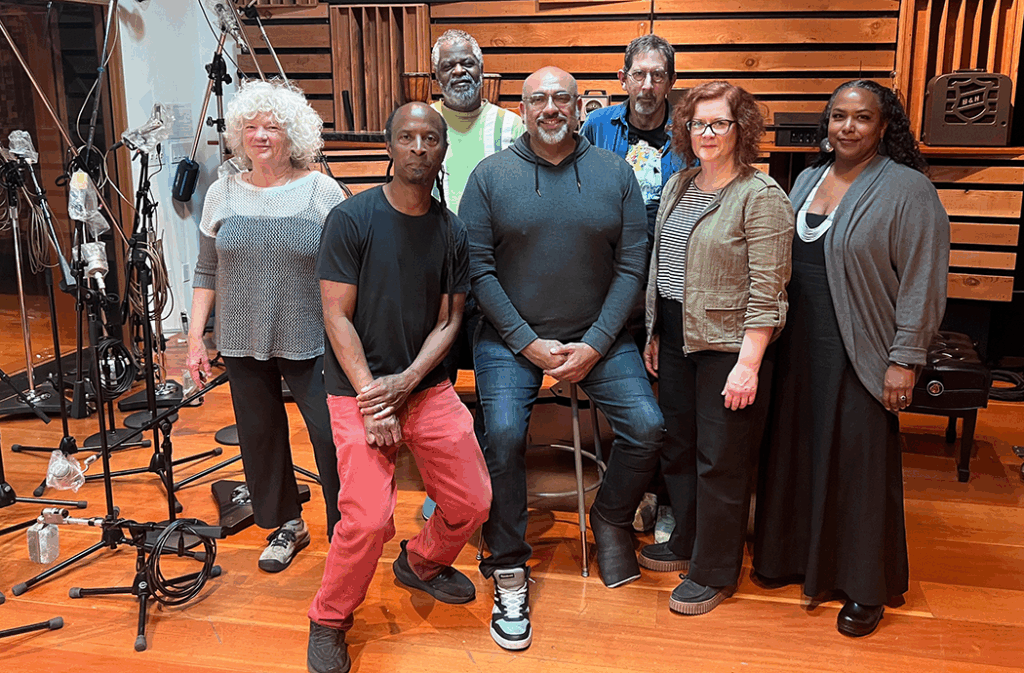
The ensemble includes Alan Williams (trombone, voice), Beth Custer (clarinet, voice), Keith Lawrence (viola, voice), David James (guitar, voice), Lisa Mezzacappa (bass), and John Hanes (drums), with Allegra Bandy and Sólás Burke-Lalgee on voice.
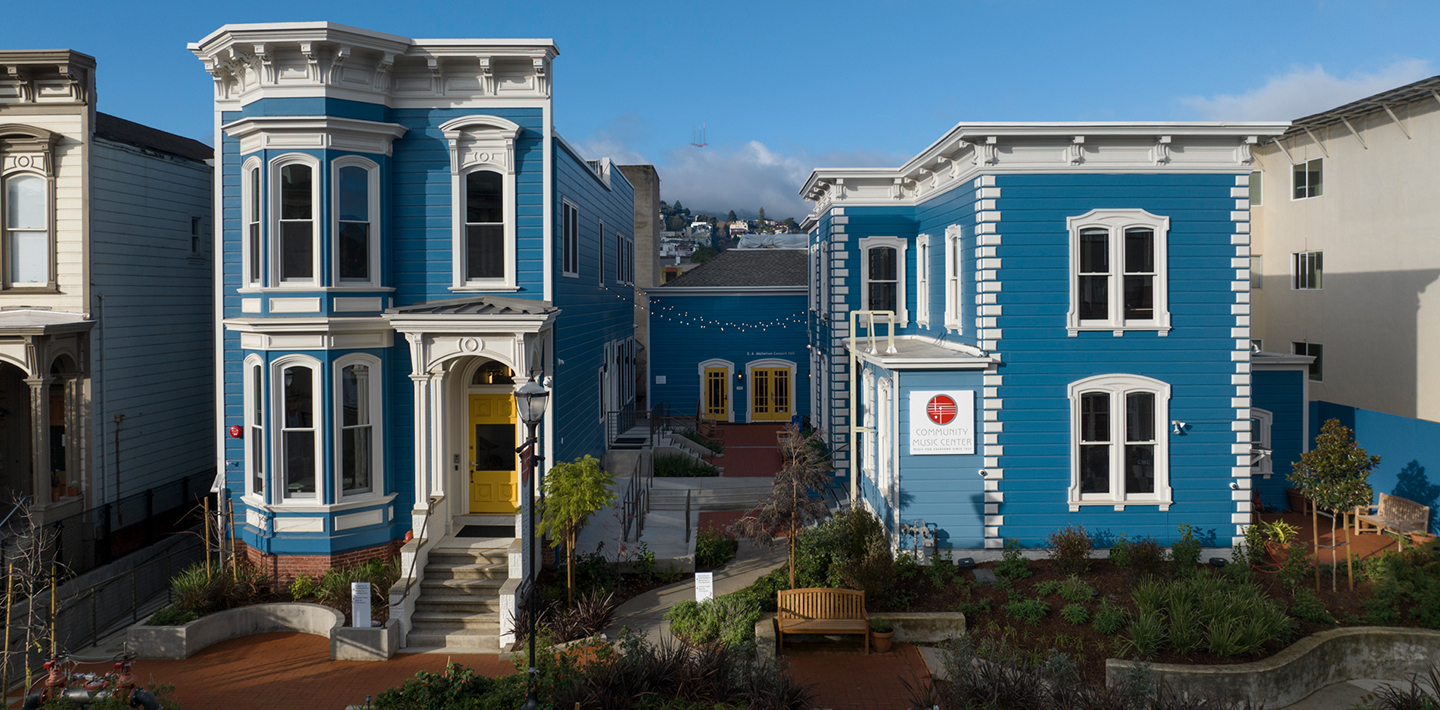
Hosting the release at CMC felt like a natural fit.
“I had my first CMC experience about 6 months ago, when I saw a performance by Robert Lopez and his ensemble. It was a great show, and it was then that I really think of CMC as a potential location for the album release. As I looked into the tech specs and the costs, it began to seem even more like the perfect place for this concert. Finally—especially—the more I interacted with the CMC folks involved (Shannon, Jonah, Cory, Beto) the more my decision was validated! Everyone was so nice, so helpful. It made a potentially chaotic situation really smooth.”